

The Secret to the Perfect Medium-Rare Steak
Your Rib & Chop House Guide to Cooking the Perfect Medium-Rare Steak
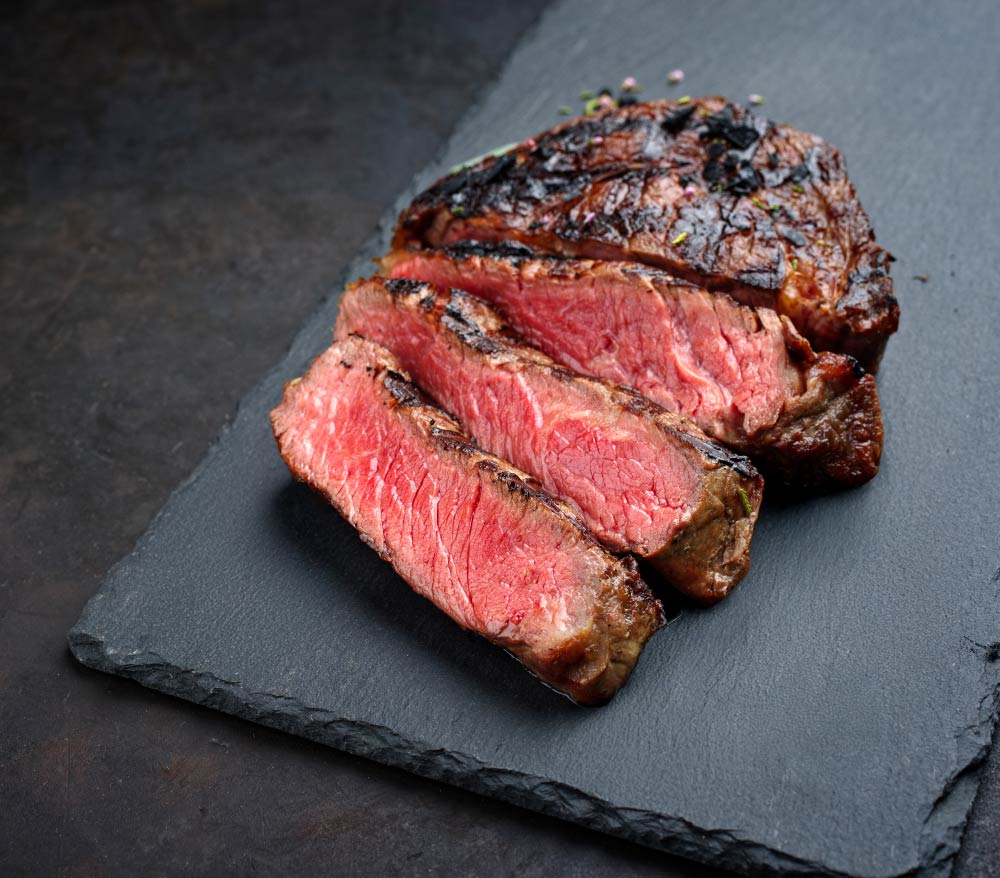
Medium-rare is the sweet spot. At Rib & Chop House, it’s what we do day in and day out, and the principles behind a perfect medium-rare aren’t complicated. 130–135°F is where the fat renders, the juices stay put, and the texture hits that tender-but-substantial mark that makes a great steak worth talking about. It’s not undercooked. It’s exactly right.
The problem is that most people either overcook out of caution or undercook from impatience. The good news? The difference between a great medium-rare and a disappointing one usually comes down to a handful of things—none of which require culinary school.
Know Your Doneness
Before you cook, it helps to know what you’re actually aiming for. A meat thermometer is highly encouraged to get the perfect temperature. Here’s a quick breakdown:
- Rare (120–125°F): Deep red center, very soft. Great for certain cuts, but polarizing.
- Medium-Rare (130–135°F): Warm pink center, juicy, tender. The sweet spot.
- Medium (140–145°F): Light pink center, firmer texture. Still good, but you’re losing juice.
- Medium-Well (150–155°F): Barely pink, noticeably drier.
- Well-Done (160°F+): Gray throughout, tough. We won’t lecture you, but we will gently discourage it.
Medium-rare wins because it’s the temperature where a steak’s fat and connective tissue have had just enough heat to break down without the muscle fibers tightening up and squeezing out moisture.
Start with the Right Cut
Before you touch a pan, you need the right steak. A ribeye is the most forgiving—heavy marbling means more fat to work with, and fat is flavor. A New York strip is leaner and bold. A filet is the most tender cut on the animal, but it has almost no margin for error. A T-bone gives you both the strip and the filet in one.
When you’re buying, look for good marbling (those thin white streaks of fat running through the meat). More marbling means more flavor and a more forgiving cook. The color should be bright, cherry red; avoid anything that looks brown or gray at the edges.
Whatever you choose, thickness matters. Shoot for at least an inch, ideally an inch and a half. Thin steaks cook too fast, and by the time you’ve got a crust, you’ve already blown past medium-rare.
Don’t Skip the Prep
This is where most home cooks lose the game before it even starts.
Pull your steak from the fridge 30-45 minutes before cooking. Cold steak hitting a hot pan means the outside cooks faster than the center, leaving an uneven cook from edge to center. Room temperature steak gives you better control.
Pat it dry. Moisture on the surface of your steak steams instead of sears, and a steamed steak has no crust. Paper towels, 30 seconds, done.
Season it well. Kosher salt and cracked black pepper are your friends. Either do it at least 45 minutes ahead so the salt can work its way in, or do it right before it hits the pan. The in-between window—10 to 40 minutes—is where you get a wet surface and pale crust. Avoid it.
Pick Your Cooking Method
Cast iron on the stovetop gives you the best crust and the most control. It’s the go-to for most cuts.
The grill adds smokiness and is great for thicker cuts. Get it screaming hot and make sure the grates are clean and oiled.
The reverse sear is the most consistent method for thick steaks (1.5 inches or more): bring the steak up slowly in a low oven (250°F) until it hits about 115°F internally, then sear it hard in a cast-iron pan to finish. You get edge-to-edge even doneness with a serious crust. Takes more time, worth every minute.
High Heat. No Negotiating.
Whatever method you choose, you need high heat to build a proper crust. No crust means no flavor development, and no one wants a gray, sad steak.
For the stovetop, let your cast iron preheat for a few minutes until a drop of water bounces and evaporates almost instantly. Add a high-smoke-point oil, lay the steak down, and don’t move it. For a 1-inch steak, you’re looking at roughly 3–4 minutes per side. For 1.5 inches, closer to 4–5. Use a thermometer. Guessing is how you end up with a $20 steak cooked to medium-well by accident.
In the last minute or two, add butter, a smashed garlic clove, and fresh thyme. Tilt the pan and baste repeatedly. This is the move that makes a steakhouse steak taste like a steakhouse steak.
Let it Rest
Pull the steak off the heat at 125-128°F. It’ll carry over to 130-135°F while it rests. Tent it loosely with foil and leave it alone for at least 5-10 minutes.
The resting period lets the muscle fibers relax, and juices redistribute. Cut into it too early, and those juices run straight onto your cutting board instead of staying in the meat. The crust holds up fine. The steak won’t go cold. Trust the process.
Finish Strong
Slice against the grain. This shortens the muscle fibers, making every bite more tender. Add a small pat of compound butter or a pinch of flaky sea salt right before serving.
That’s it. No secret sauce. No overcomplicated technique. Just a few principles done right.
Of course, some nights you’d rather let someone else handle it. At Rib & Chop House, medium-rare is what we do best. We’ve got a table waiting whenever you’re ready.